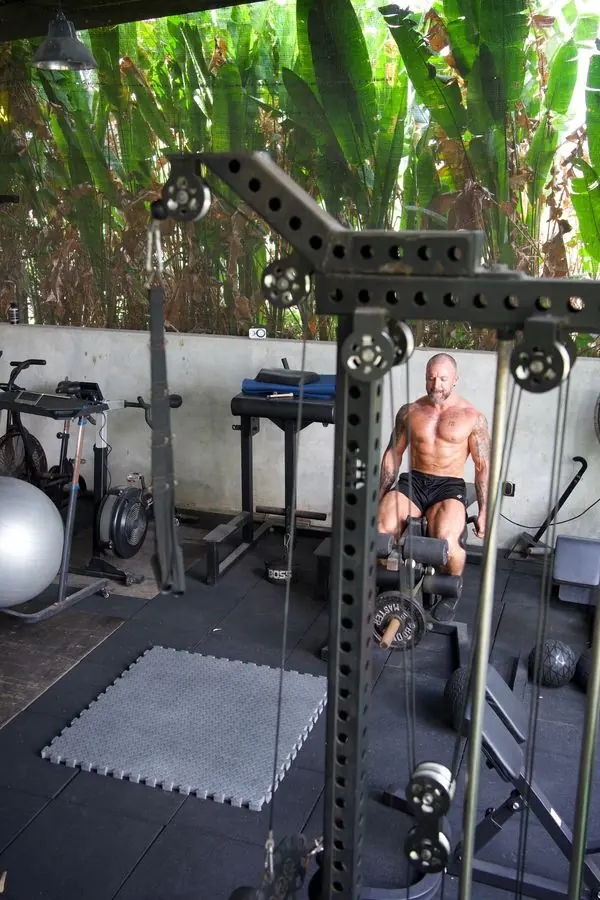
Whole body training builds muscle. The research backs it, and the setup is simpler than most split routines.
The catch is that it only works when you run it right. You need enough weekly volume, enough variety across the week, and a plan for the muscles that lag behind. This guide covers what the studies show, how the Whole Body Strength Matrix is built for growth, and the mistakes that stall progress.
What the Research Says About Frequency
Training frequency means how often you train a muscle each week. A split routine hits a muscle once a week. A whole body routine hits it three or four times.
The evidence on frequency looks like this:
- A 2016 meta-analysis found that training a muscle twice a week produced better growth than once a week, with volume matched between groups. The authors concluded that major muscle groups should be trained at least twice a week.[^1]
- A 2018 meta-analysis of 25 studies found no meaningful difference between higher and lower frequencies when total volume was equal. For a given volume, the authors said you can pick the weekly frequency you prefer.[^2]
- A 2025 meta-regression of 67 studies found that frequency had a negligible effect on muscle growth once volume was accounted for. It did find a consistent effect on strength gains, with diminishing returns.[^3]
Put those together and the picture is clear. Frequency works as a tool for spreading your weekly volume across more sessions. Each session stays productive, and no single day gets buried under too many sets.
Whole body training does that by design.
What the Research Says About Volume
Volume means the number of hard sets you do per muscle each week. This is the variable with the strongest link to growth.
- A 2017 meta-analysis found a graded dose-response relationship. More weekly sets produced more muscle, with each added set linked to roughly 0.37% more gain.[^4]
- The 2025 meta-regression confirmed that growth rises as volume rises, with diminishing returns at higher volumes.[^3]
- A 2023 network meta-analysis of 119 hypertrophy studies found that all resistance training prescriptions built muscle compared with no training, and that they did so comparably. The top-ranked setup for hypertrophy was higher-load, multiple-set training done twice a week.[^5]
The takeaway is practical. Do enough sets, train each muscle more than once a week, and keep the loads honest. The exact split you choose matters far less than most gym culture suggests.
How the Whole Body Strength Matrix Builds Muscle
The Matrix trains four movement patterns every session: Squat, Hinge, Push, and Pull. Each pattern gets worked three to four times a week, which puts every major muscle group at or above the twice-a-week mark from the frequency research.
What changes from day to day is the method, not the pattern. That is how the Matrix adds volume without piling the same stress onto the same tissue every session. Different loading styles hit the muscle and the connective tissue in different ways, so you can train often without beating up your joints.
Here is how the four-day layout puts growth to work:
- Day 1: 3x5 strength plus heavy hypertrophy. Heavy work builds the base of strength and drives growth in the main movers.
- Day 2: 8x3 plus MetCon. Eight sets of three adds high-quality volume at a heavy load, followed by conditioning.
- Day 3: Giant Cluster sets plus Loaded Carries. Giant Clusters stack sets of a lift with short rests inside the set, which packs a lot of work into one block. Carries load the upper back, grip, and trunk.
- Day 4: individualized hypertrophy plus Loaded Stretches. This day goes to your lagging muscle groups. Loaded Stretches use weight in a lengthened position.
On a three-day schedule, the Matrix compresses this. Loaded Stretches move to Day 1. MetCon and Loaded Carries share Day 2. Cardio and corework take Day 3. You keep all four patterns in every session either way.
The Lagging Muscle Day
Every lifter has a muscle that falls behind. For some it is the upper back. For others it is the glutes, the arms, or the calves.
A whole body plan can hide this problem, because the big lifts reward whatever you are already good at. The individualized hypertrophy day on the four-day layout fixes that. You pick the muscle groups that need extra work and give them direct volume. If you only have three days, add a few extra sets for the lagging muscle at the end of Day 1.
Can You Build Muscle and Still Do Conditioning?
The Matrix includes MetCon, carries, and cardio, so this question matters.
A 2022 meta-analysis of 43 studies compared strength training alone with strength training plus aerobic work. It found no loss in muscle growth or maximal strength from adding the aerobic work. Explosive strength dropped a little, mostly when both were done in the same session. The authors found no difference by age, including lifters over 40.[^6]
That fits how the Matrix is built. Conditioning lives in specific slots, so it supports your fitness without taking over the session. If explosive power is a priority for you, keep the heaviest, fastest work at the start of the day and do conditioning last.
Mistakes That Stall Muscle Growth on a Whole Body Plan
- Too few hard sets. Three days a week is not a reason to do three exercises a day. Your weekly volume still has to climb over time.
- Training every set to failure. Whole body frequency means you come back to the same muscles soon. Leave some reps in the tank on most sets.
- Never changing the exercises. Rotate your lineup every four to eight weeks. The same lifts for months give diminishing returns and raise the odds of overuse problems.
- Skipping the lagging muscles. The big lifts will not fix a weak point. Give it direct work.
- Not progressing. Add reps, load, or sets over time. A log makes this easy.
- Under-eating and under-sleeping. Training gives the signal to grow. Food and sleep supply the material and the recovery.
Match the Plan to How You Recover
Two people can run the same program and get different results, because they do not recover the same way. Some people handle high frequency and heavy loads well. Others need more rest between hard days and fewer sets per session.
The Neurobuild quiz shows which of the three types you lean toward, so you can adjust volume and recovery to fit. Training mechanics stay the same. The way you tune them changes.
FAQ
Can you build as much muscle with whole body training as with a split? Yes. When total weekly volume is matched, research shows similar muscle growth across different frequencies.[^2] The best plan is the one you can repeat week after week.
How many days a week should I train for muscle growth? Three to four days works well for most people. That gives each muscle at least two exposures a week, which the frequency research supports.[^1]
Is whole body training only for beginners? No. Advanced lifters use whole body formats too. The meta-analyses above found frequency effects were similar in resistance-trained lifters when volume was equal.[^2]
How many sets per muscle should I do each week? More sets lead to more growth up to a point, with diminishing returns as volume climbs.[^3][^4] Start with what you can recover from, add sets slowly, and track your results.
What if one muscle group is behind the rest? Give it direct work. On the four-day Matrix, that is what Day 4 is for. On three days, add extra sets at the end of Day 1.
The Bottom Line
Whole body training builds muscle because it makes it easy to hit the two things that matter most: enough weekly volume, and enough weekly frequency to spread it out. The Whole Body Strength Matrix adds method rotation, a lagging muscle day, and built-in conditioning on top.
Start with the Whole Body Strength Matrix pillar for the full framework, then see Whole Body Strength Circuits for how to run sets, reps, and rest inside a session.
References
Sources retrieved from PubMed.
[^1]: Schoenfeld BJ, Ogborn D, Krieger JW. Effects of Resistance Training Frequency on Measures of Muscle Hypertrophy: A Systematic Review and Meta-Analysis. Sports Med. 2016;46(11):1689-1697. doi:10.1007/s40279-016-0543-8 [^2]: Schoenfeld BJ, Grgic J, Krieger J. How many times per week should a muscle be trained to maximize muscle hypertrophy? J Sports Sci. 2019;37(11):1286-1295. doi:10.1080/02640414.2018.1555906 [^3]: Pelland JC, Remmert JF, Robinson ZP, Hinson SR, Zourdos MC. The Resistance Training Dose Response: Meta-Regressions Exploring the Effects of Weekly Volume and Frequency on Muscle Hypertrophy and Strength Gains. Sports Med. 2026;56(2):481-505. doi:10.1007/s40279-025-02344-w [^4]: Schoenfeld BJ, Ogborn D, Krieger JW. Dose-response relationship between weekly resistance training volume and increases in muscle mass. J Sports Sci. 2017;35(11):1073-1082. doi:10.1080/02640414.2016.1210197 [^5]: Currier BS, et al. Resistance training prescription for muscle strength and hypertrophy in healthy adults: a systematic review and Bayesian network meta-analysis. Br J Sports Med. 2023;57(18):1211-1220. doi:10.1136/bjsports-2023-106807 [^6]: Schumann M, et al. Compatibility of Concurrent Aerobic and Strength Training for Skeletal Muscle Size and Function: An Updated Systematic Review and Meta-Analysis. Sports Med. 2022;52(3):601-612. doi:10.1007/s40279-021-01587-7