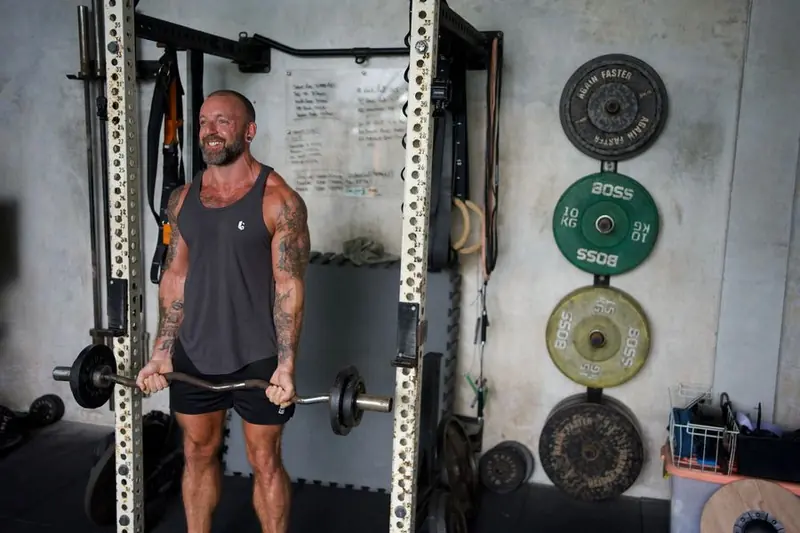
You have two big choices for how to lay out your week. You can train your whole body each session. Or you can split the body up and train a few muscles per day. Both work. The research is clear on that. The better question is which one fits your life, your joints, and your goals.
This post gives you the evidence, a side-by-side table, and a simple way to choose. It is part of the Whole Body Strength Matrix series.
What Each Style Means
Whole body training means you hit all the major movement patterns in every session. You squat, hinge, push, and pull each time you train.
Split training means you divide the body across days. A common version is "push, pull, legs." Another is "upper body, lower body." Each muscle gets trained once or twice a week.
Two terms come up a lot, so here they are in plain words. Training volume is the total amount of hard work you do in a week, usually counted in sets. Frequency is how often you train a muscle in a week. Hypertrophy is the science word for muscle growth.
What the Research Says
Start with the biggest finding. When weekly volume is the same, how you split it up matters very little.
A 2024 review pooled 14 studies and 392 people who used either a split or a whole body routine. Strength gains and muscle growth were similar in both groups when volume was equal [2]. An earlier review of 25 studies found the same thing for training frequency. With volume equal, higher and lower frequencies did not differ in a meaningful way [1].
Strength follows the same pattern. A review of 22 studies found that more frequent training seemed to raise strength gains. But when the studies matched volume, that edge went away [7]. A 2025 analysis of 67 studies agreed that volume drives most of the result. It found that frequency has a small, steady link to strength gains and a negligible link to muscle growth [10].
So what actually moves the needle? Total weekly work. A review of 15 studies found that more weekly sets were linked to more muscle growth [8]. In the groups that did 10 or more sets per muscle per week, gains trended higher than in groups doing fewer than five. (That 10-set figure comes from the research, not from the Whole Body Strength Matrix.)
Some Studies Lean One Way or the Other
Single studies are small, and they do not all agree. Here is a fair look.
- In 20 well-trained men, training each muscle three times a week led to more forearm growth than once a week. Strength gains were the same [3].
- In 36 trained men, a split routine (each muscle twice a week) and a whole body routine (three times a week) gave similar results. The size differences slightly favored the split [4].
- In 21 trained men, the split group grew more thigh muscle thickness. The whole body group did better on one strength test [5].
- In 50 women new to lifting, a whole body routine and a split routine gave the same strength and muscle gains [6].
- In 23 well-trained men, the whole body group lost more body fat than the split group over eight weeks. That is one small study, so treat it as an early hint that needs more research [9].
The pattern is mixed, and the mix points to a plain answer. Neither style wins on its own.
One more point. Most of these studies used young adults. The research on people over 40 is thinner. Use the numbers above as a guide and watch how your own body responds.
Side-by-Side Comparison
| Whole Body | Split | |
|---|---|---|
| Muscle growth (equal weekly work) | Similar | Similar |
| Strength gains (equal weekly work) | Similar | Similar |
| Practice of each lift | Often, so skills improve fast | Less often |
| Missed session | Small loss, since every pattern shows up again soon | Bigger loss, since a muscle may wait a full week |
| Session length | Shorter or moderate | Can run long for each body part |
| Days needed | 3 to 4 | 4 to 6 |
| Recovery between hits on a muscle | Spread out | Concentrated on one day |
| Best for | Busy schedules, steady strength work | Lifters who like long, focused sessions |
How the Whole Body Strength Matrix Handles This
The Matrix is a whole body system built for people over 40 who train three to four days a week. Every session covers four movement patterns: squat, hinge, push, and pull. So each pattern is trained three to four times a week.
The smart part is what changes from day to day. The patterns stay the same. The method rotates. That spreads the stress across your joints and connective tissue instead of hammering the same tissue the same way every day.
Here is the four-day layout:
- Day 1: 3x5 strength work plus heavy hypertrophy work.
- Day 2: 8x3 (eight sets of three reps) plus a MetCon. A MetCon is a short, hard conditioning block that raises your heart rate.
- Day 3: Giant Cluster sets plus Loaded Carries. A Loaded Carry means walking while you hold heavy weight.
- Day 4: Hypertrophy work for lagging muscle groups plus Loaded Stretches. A Loaded Stretch means holding a stretched position under load.
On a three-day week, the Loaded Stretches move to Day 1. The MetCon and Loaded Carries share Day 2. Day 3 becomes cardio and core work.
You can read the full breakdown in the pillar post on the Whole Body Strength Matrix. For a circuit-style take on whole body work, see Whole Body Strength Circuits.
Why Whole Body Training Suits Many Adults
The research says both styles can build muscle. Real life adds a few other things to weigh.
Life gets in the way. You will miss sessions. On a split, a missed leg day can mean your legs go ten days with no work. On a whole body plan, the next session brings every pattern back.
Skill needs practice. Squats and hinges are skills. More touches per week gives you more chances to groove clean form.
Joints like variety. Rotating methods across days gives tissue time to adapt. This is the logic behind the Matrix.
Time is tight. Three or four sessions fit most calendars. Five or six do not.
When a Split Can Make Sense
A split is a fine choice in some cases.
- You enjoy long, focused sessions on one body area.
- You have six days a week to train and want to use them.
- You are bringing up one stubborn muscle and want extra volume on it.
The Matrix covers that last case already. Day 4 in the four-day layout is built for lagging muscle groups. You get the focus of a split without giving up whole body structure.
Common Mistakes
- Choosing by what a pro does. Pros often run splits, and they also have more time, more recovery tools, and different goals. Pick based on your week.
- Counting sessions and ignoring sets. If your weekly work is low, neither style will help much. Track your total sets.
- Switching plans every few weeks. Any good plan needs time to work. Give one routine a full block before you judge it.
- Doing too much per session on a whole body plan. Every pattern each day does not mean every exercise each day. Keep sessions focused.
- Skipping recovery. More frequent training needs good sleep and food. Gains happen when you recover.
How to Choose
Use these steps.
- Count the days you can train for the next three months. Be honest.
- If it is three or four, start with whole body.
- If it is five or six and you love long sessions, a split can work.
- Pick weekly sets first. Then spread them across your days.
- Run the plan for at least a full block before you change it.
If you want help matching your training style to how your body and brain respond, take the Neurobuild quiz.
FAQ
Is whole body training better for fat loss?
One eight-week study of 23 well-trained men found more fat loss in the whole body group than in the split group [9]. It is one small study, so more research is needed. Your food intake matters far more than your training layout.
Can I build muscle with only three days a week?
Yes. In studies where weekly volume was equal, three-day whole body plans built muscle as well as plans with more days [1, 2]. Your weekly sets still need to be high enough to push growth.
Do I need to train a muscle twice a week?
The research shows that once-a-week and more frequent training can give similar growth when volume is equal [1]. Training a pattern several times a week gives you more practice and spreads out the work. That is a practical benefit, even though the muscle itself does not demand it.
Does age change the answer?
The studies mostly used young adults, so the answer for people over 40 is not as well tested. One review found that frequency effects on strength were clearer in young adults than in middle-aged and older adults [7]. This is one more reason to pick a plan you can recover from and repeat.
Which is easier to stick with?
Most people find a plan with fewer, repeatable days easier to keep. The best plan is the one you will still be doing in six months.
The Bottom Line
Both styles build muscle and strength when your weekly work is the same. Choose the one that fits your schedule, your joints, and your habits. For most busy adults, that is whole body training. Start with the Whole Body Strength Matrix, run it for a full block, and track your sets.
References
- Schoenfeld B, et al. How many times per week should a muscle be trained to maximize muscle hypertrophy? A systematic review and meta-analysis of studies examining the effects of resistance training frequency. J Sports Sci. 2019. doi:10.1080/02640414.2018.1555906
- Ramos-Campo D, et al. Efficacy of split versus full-body resistance training on strength and muscle growth: a systematic review with meta-analysis. J Strength Cond Res. 2024. doi:10.1519/JSC.0000000000004774
- Schoenfeld B, et al. Influence of resistance training frequency on muscular adaptations in well-trained men. J Strength Cond Res. 2015. doi:10.1519/JSC.0000000000000970
- Lasevicius T, et al. Similar muscular adaptations in resistance training performed two versus three days per week. J Hum Kinet. 2019. doi:10.2478/hukin-2019-0062
- Bartolomei S, et al. A comparison between total body and split routine resistance training programs in trained men. J Strength Cond Res. 2021. doi:10.1519/JSC.0000000000003573
- Pedersen H, et al. A randomized trial on the efficacy of split-body versus full-body resistance training in non-resistance trained women. BMC Sports Sci Med Rehabil. 2022. doi:10.1186/s13102-022-00481-7
- Grgic J, et al. Effect of resistance training frequency on gains in muscular strength: a systematic review and meta-analysis. Sports Med. 2018. doi:10.1007/s40279-018-0872-x
- Schoenfeld B, et al. Dose-response relationship between weekly resistance training volume and increases in muscle mass: a systematic review and meta-analysis. J Sports Sci. 2017. doi:10.1080/02640414.2016.1210197
- Carneiro MAS, et al. Full-body resistance training promotes greater fat mass loss than a split-body routine in well-trained males: a randomized trial. Eur J Sport Sci. 2024. doi:10.1002/ejsc.12104
- Pelland JC, et al. The resistance training dose response: meta-regressions exploring the effects of weekly volume and frequency on muscle hypertrophy and strength gains. Sports Med. 2025. doi:10.1007/s40279-025-02344-w